
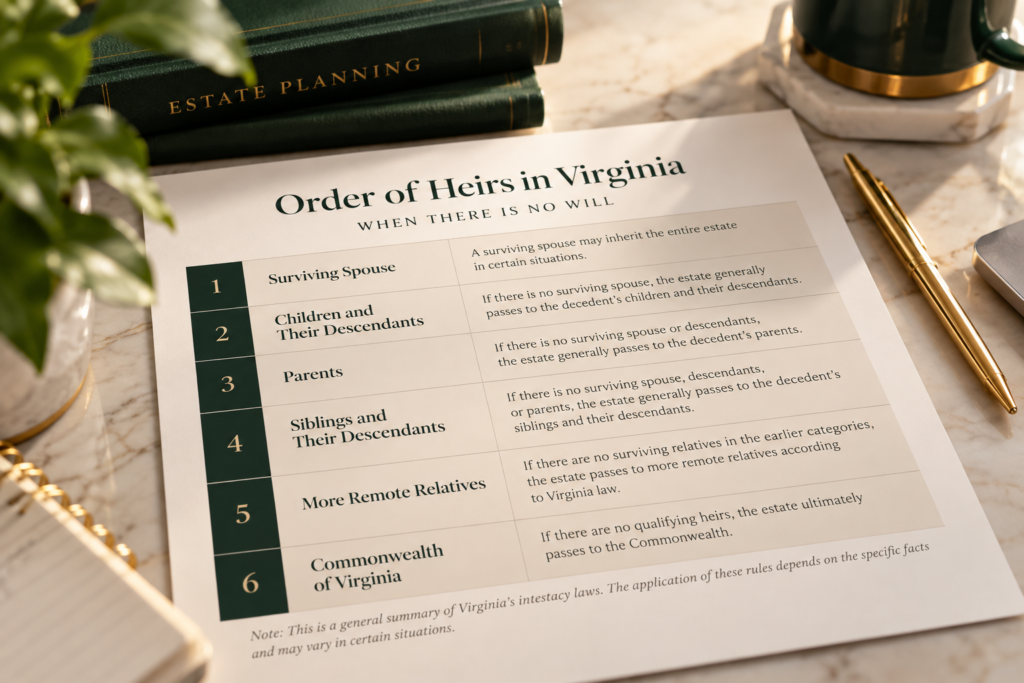
What Happens If You Die Without a Will in Virginia?
Dying without a will does not mean that no one inherits your property.
It means Virginia law decides who inherits certain property instead of you.
This is called dying intestate. Virginia’s intestacy laws provide a default order for distributing property that is not otherwise effectively disposed of through a will or another method.
That default plan may work for some families.
For others, it may look very different from what they assumed would happen.
If You Are Married, Does Everything Go to Your Spouse?
Sometimes—but not always.
Under Virginia law, if you die with a surviving spouse, your spouse generally inherits the intestate estate when all of your descendants are also descendants of your surviving spouse.
The result changes when you have a child or other descendant who is not also a descendant of your surviving spouse.
In that situation, Virginia’s intestacy statute generally provides:
1/3 to the surviving spouse
2/3 to the decedent’s children and their descendants
This is one reason intestacy can be particularly important for blended families.
The law applies its formula. It does not know whether you wanted your spouse financially protected first, whether you intended particular property to go to your children, or whether you consider your stepchildren part of your intended inheritance plan.
What If You Are Not Married?
If there is no surviving spouse, Virginia law generally looks next to the decedent’s children and their descendants.
If there are no surviving descendants, the law moves through additional family relationships, including parents, siblings and their descendants, and then more remote relatives according to the statutory order.
This can be particularly important for unmarried couples.
A long-term partner does not become a spouse simply because you have built a life together. Virginia’s intestacy laws distribute property according to legally recognized family relationships—not according to who was emotionally closest to the person who died.
If providing for an unmarried partner is important to you, relying on intestacy may not accomplish that objective.
Intestacy Does Not Mean the State Automatically Takes Everything
One persistent misconception is:
“If I die without a will, the state gets my property.”
Usually, no.
Virginia law provides an extensive order for identifying heirs. Property generally reaches the Commonwealth only when there is no person entitled to inherit under the statutory succession rules.
The more practical concern is usually not that Virginia will take everything.
It is that Virginia may distribute your property differently than you would have chosen.
Not Everything You Own Is Necessarily Controlled by Intestacy
This is where estate planning becomes more nuanced.
Dying without a will does not necessarily mean every asset you own gets placed into one pot and divided according to Virginia’s intestacy laws.
How an asset passes can depend on how it is owned and whether another arrangement controls what happens to it.
Beneficiary designations, certain forms of joint ownership, trusts, and other arrangements may determine how particular assets pass.
So the question is not simply:
“Who are my heirs under Virginia law?”
It is also:
“What do I own, how do I own it, and what currently controls where each asset goes?”
That is why estate planning involves more than simply drafting a will.
A Will Does More Than Decide Who Gets Property
Inheritance is also only one part of the planning conversation.
A thoughtful estate plan may address questions such as:
- Who do you want handling the administration of your estate?
- Who should manage property left for children or other beneficiaries?
- Who should make financial decisions for you if you become incapacitated?
- Who should make health-care decisions if you cannot make them yourself?
- Should certain beneficiaries receive property outright, or should it be managed for them?
Your estate plan gives you an opportunity to make intentional choices about these issues rather than leaving everything possible to statutory defaults.
What About Minor Children?
Parents sometimes assume that having a will is primarily about deciding who receives their property.
For parents of minor children, there can be much more to consider.
Who would you want caring for your children if both parents were unavailable? Who should manage the property your children inherit? Should the person caring for the children also be the person managing their inheritance? At what point should a child receive control of inherited property?
Simply saying “everything goes to my children” does not answer all of those questions.
Virginia Has a Plan for You. The Question Is Whether You Want It.
Intestacy laws serve an important purpose. There must be a way to determine what happens when someone dies without leaving legally effective instructions for property that must pass through the intestate estate.
But Virginia’s default rules were not written specifically for your family.
They do not know which relationships matter most to you, what you want to happen to your home, whether you want to provide for an unmarried partner or stepchild, how you want children to receive an inheritance, or who you trust to carry out your wishes.
Estate planning gives you the opportunity to answer those questions yourself.
Ready to Create Your Own Plan?
Basis Law PLLC assists Virginia individuals and families with estate planning designed around their relationships, assets, priorities, and goals.
Schedule an estate-planning consultation to discuss what you want your plan to accomplish.
This article is provided for general informational and educational purposes only and does not constitute legal advice. The distribution and administration of an estate depends on the particular facts, property involved, family relationships, and applicable law. Reading this article, visiting this website, contacting Basis Law PLLC, or scheduling a consultation does not create an attorney-client relationship. Representation requires a written engagement agreement with Basis Law PLLC.
Informational notice: This resource is provided for general informational purposes only and is not legal or tax advice. Reading this article, contacting Basis Law PLLC, or submitting information does not create an attorney-client relationship. Legal outcomes and procedural options depend on the specific facts and applicable law.